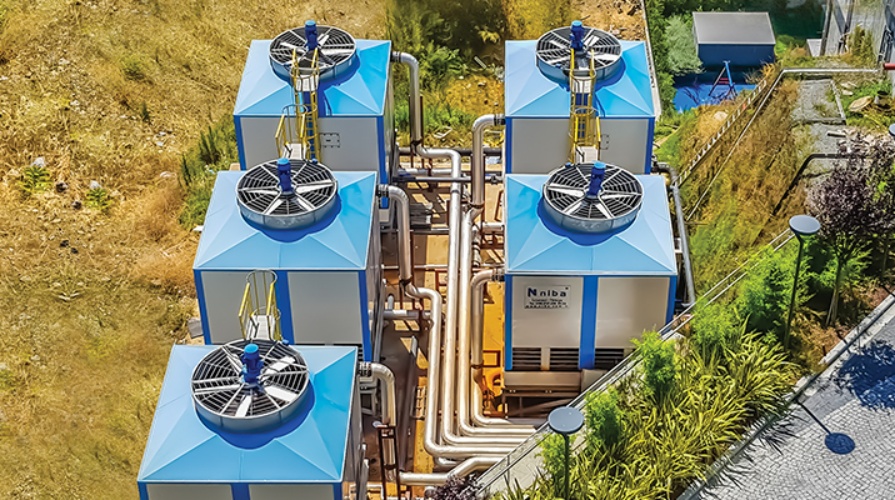
Coolıng Tower Chemıcals
The correct water treatment program is one of the areas that provides the largest savings and efficiency in operation. There are three main problems encountered in water cooling towers: scaling, corrosion, and biological growth. These issues not only
Chemicals for cooling towers play a crucial role in ensuring the energy efficiency and smooth operation of the cooling system over many years. Our conditioning programs, based on products developed specifically for cooling towers and supported by thorough analysis, aim to provide lasting solutions to these problems.
Corrosion and Scale Inhibitor Chemicals
Niba CTN 2856: A corrosion and scale inhibitor for open and semi-open cooling water systems fed with hard water.
Niba CTN 300-P: A corrosion and scale inhibitor for open and semi-open cooling water systems fed with hard water. (pH controlled)
Niba CTN 2000: A corrosion and scale inhibitor for open, semi-open, and closed cooling water systems fed with soft water.
Niba CTN 2046: Used as a copper metal corrosion inhibitor. Can be used in conjunction with a specific scale and corrosion inhibitor chemical for copper protection.
Niba CTN 2050: A dispersant product for cooling tower systems with high hardness and silicate content, used for scale removal. Can be used in conjunction with a scale and corrosion inhibitor chemical.
Biocides
Biocides are chemicals that are used to kill or control microorganisms such as fungi, algae,bacteria, and protozoa that can develop and grow in aqueous systems. They are also recommended for controlling Legionella bacteria. Selecting the correct biocide and determining the appropriate dosage is crucial depending on the system to be treated.
Niba CTN 520: Non-oxidizing biocidal product used to prevent microbiological growth in open, semi-open, and closed systems.
Niba CTN 320: Biocidal product used to prevent microbiological growth in open, semi-open, and closed systems.
Niba CTN 530-L: Chlorine activator product used to prevent microbiological growth in open systems.